How OnSite supported the repair of a deteriorated twin barrel bridge culvert using GRP segmental lining
The challenge
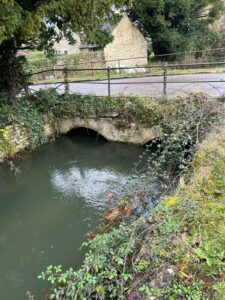
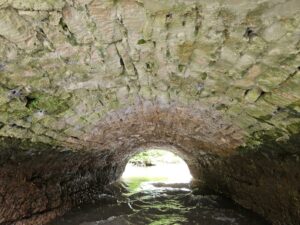
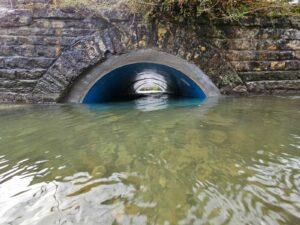
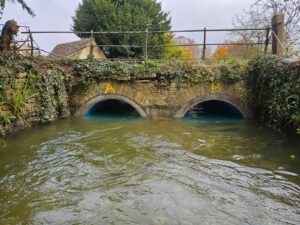
OnSite was contracted by Island Roads, on behalf of Ringway, to deliver a repair solution for a badly deteriorated twin barrel bridge culvert. The bridge was located over the River Coln, close to Quenington Mill.
In preparation for the works, a detailed rehabilitation plan was developed to install glass reinforced plastic (GRP) liner sections within both culverts, restoring their structural integrity and extending their service life.
Action
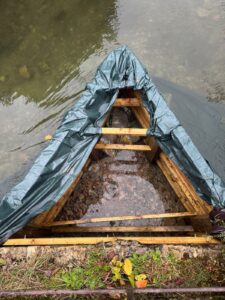
The first stage of the project involved temporary water management measures to reduce water levels in one culvert while keeping the river flowing through the adjacent culvert. Flow levels were controlled using existing weirs and temporary dam boards, which diverted water away from the work area. Any remaining water was pumped out, creating a dry and safe working environment for the installation of the GRP liner.
Once the water level had been reduced sufficiently, rocks, debris and other obstructions were removed, and the culvert was then measured to ensure there was adequate space for the GRP liner to be installed.
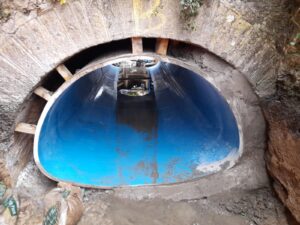
Guide rails were fitted along the floor of the culvert to help the segments of GRP liner slide smoothly into position and maintain the correct alignment during installation. The GRP liner was then lifted from the bridge and lowered to the downstream end with a telehandler. Once in position the liner was winched in, one section at a time, through the culvert to the finishing point. Care was taken to ensure that each new section connected securely to the previous one, forming a continuous liner. The process was repeated until all the segments were installed throughout the entire length of the culvert.
Once all GRP liner sections had been installed, they were temporarily secured with wooden wedges. The annular space between the liner and the existing culvert was sealed and filled with high-strength grout, creating a fully bonded structural lining. After the grout had set, the temporary flow diversion measures were transferred to the adjacent culvert and the process was repeated.
Results
The installation of GRP liner sections and grouting of the annular void successfully rehabilitated the existing culverts, creating a durable, corrosion-resistant channel within the original structure. The works restored structural integrity, improved long-term asset reliability and extended the service life of the culverts while minimising disruption compared with full replacement.
Health and safety considerations
Due to the nature of the environment, the team had to consider:
- confined space working within the culverts
- management of water diversion and flood risks
- structural stability of the existing assets
- lifting and installation of GRP liner sections
- the safe handling and pumping of high-strength grout.
Detailed risk assessments, emergency rescue procedures and temporary works designs were implemented to ensure the safety of our team and the quality of the rehabilitation work.
Download Case Study